 AI Partner
Rogue Security
AI Agent Runtime Protection
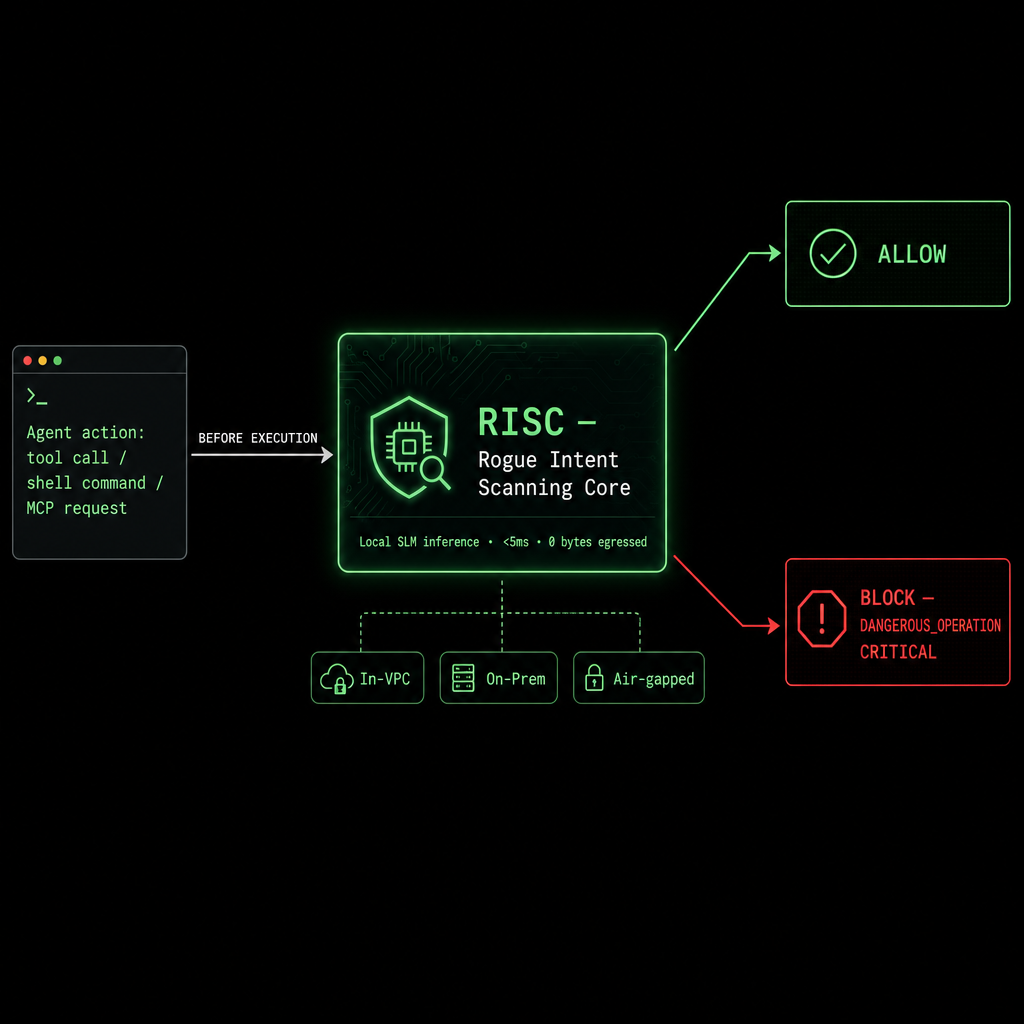
The RISC engine intercepts every tool call your AI coding agents fire — file access, shell commands, MCP server calls — and enforces policy before execution. Sub-5 ms latency. Zero data egress. No agent modifications required.
— THE THREE-AGENT PROBLEM
What is Rogue Security?
Enterprise environments now run three distinct classes of AI agent simultaneously — each with a different runtime footprint, threat surface, and blind spot in your current security stack. Rogue Security was built to protect all three.
The defining challenge is not the model or the prompt — it is the tool call: the moment an AI agent executes an action in the real world. File writes, shell commands, API calls, MCP server invocations. These happen at machine speed, with no human confirmation, using the full privileges of whoever launched the agent.
The RISC engine intercepts at that exact moment — before execution — and enforces policy without modifying the agent, adding latency a developer would notice, or sending data outside your environment.
- Claude Code
- Cursor
- GitHub Copilot
- Codex CLI
- Devin
- Salesforce Agentforce
- ServiceNow AI
- Notion AI
- Jira Assist
- HubSpot AI
- LangChain agents
- OpenAI Assistants
- AutoGen pipelines
- Custom MCP clients
- Internal chatbots
— WHY EXISTING TOOLS MISS THE GAP
The gap no existing tool closes
Existing tools are blind to agent behaviour
EDR watches processes. CASB watches SaaS sessions. SIEM aggregates logs after the fact. None intercept a tool call at the moment an AI coding agent fires it — which is the only moment when blocking is possible.
Agents operate below the human-approval layer
A coding agent executes shell commands, reads credential files, and calls external APIs without a human confirmation step. It inherits the full OS privileges of the developer who launched it. Existing controls assume a human in the loop.
The MCP supply chain is unscanned
Model Context Protocol servers extend agent capabilities — and introduce untrusted, third-party execution into your environment. With 250K+ MCPs in the wild, no team reviews them manually. The RISC engine does it at runtime.
| Category | What it does | What it cannot do |
|---|---|---|
| EDR | Monitors OS processes and file activity for known malware | Intercept AI agent tool calls or understand agentic intent |
| CASB | Governs SaaS application usage and data transfer | Observe in-process agent behaviour or MCP server calls |
| SIEM | Correlates security events from logs after execution | Block a dangerous tool call before it executes |
| Proxy | Filters HTTP traffic at the network boundary | Inspect local agent tool calls or enforce agentic policy |
| Rogue RISC | Runtime interception of every tool call — blocks, redacts, or allows before execution, across all three agent classes, with zero data egress and sub-5 ms latency. | |
— WHAT ROGUE SECURITY DELIVERS
Two halves of one platform
Coding Agent Protection
- Tool-call interceptionEvery file operation, shell command, code execution, and API call an agent attempts is intercepted and evaluated before reaching the OS or cloud. Sub-5 ms enforcement latency — invisible to the developer.
- MCP supply-chain controlThe RISC engine checks every MCP server call against the 250K+ entry Risk Library. Unknown, high-risk, or banned MCPs are blocked at the point of invocation — no manual review required.
- Prompt injection defenceDetects indirect prompt injection delivered through MCP tool outputs, retrieved documents, or agent memory — blocking malicious payloads before they redirect agent behaviour.
Enterprise AI Governance
- AI-SPM posture layerContinuous discovery and risk scoring of AI assets across the development estate — coding agents, LLM APIs, and custom agent deployments — with configuration drift alerts.
- Policy as codeDefine allow/deny/redact policies for agent capabilities per team, project, or environment. Policies are version-controlled, reviewable, and enforced by the RISC engine without agent-side changes.
- Audit trail & complianceEvery intercepted tool call — allowed or blocked — is logged with full context: agent identity, tool name, arguments, decision rationale. Exportable for SOC2, ISO 27001, and custom compliance needs.
— FULL PLATFORM
Three modules. One unified platform.
AI-SPM, AIDR, and AI-AppSec combine into a single platform covering posture, runtime detection, and secure development — so AI security is not a point tool but a closed loop from build to production.
Discover and score every AI agent, API, and MCP deployment. Know your attack surface before it is exploited.
Runtime detection and response for AI threats — prompt injection, tool-chain abuse, agent compromise — across coding and SaaS agents.
Shift-left security for teams building AI applications. Scan agents, prompts, and pipelines for vulnerabilities before deployment.
Rogue Risk Library
More than 250,000 MCP servers catalogued and continuously scored across 75+ attack technique categories. When your agents call an MCP server, the RISC engine queries the Risk Library in real time and enforces your policy — before the call executes. No manual review. No false sense of safety from an unapproved registry.
— DEPLOYMENT OPTIONS
Meets your environment — not the other way around
The RISC engine is available in three deployment modes. All three enforce the same policies, maintain the same sub-5 ms latency, and feed events into the same QMasters SOC dashboard.
SaaS
Fastest time-to-value. RISC engine connects to your environment over a secure tunnel. No infrastructure to manage.
In-VPC
RISC engine runs inside your cloud VPC. All telemetry stays within your network boundary. Required for regulated environments.
On-Prem
Full on-premises deployment for air-gapped or sovereign environments. Managed updates via QMasters. Zero data egress.
— DEEP DIVE
Why AI agents need their own security category
Every foundational shift in computing has created a new security category. The endpoint created EDR. Cloud created CSPM. AI agents are creating a new one — and the attack surface is already live in your developer environment today.
The organizations that recognize the coding agent as the new control point before the category is named will lead the decade that follows. The window is open now.
— FAQ
Frequently asked questions
Enterprise environments now run three distinct classes of AI agent simultaneously — endpoint coding agents (Claude Code, Cursor, Copilot), embedded SaaS agents (Salesforce Agentforce, ServiceNow AI), and custom-built agents using LangChain or the OpenAI Assistants API. Each class has a different runtime footprint and threat surface. Existing security controls were built for one class — usually the endpoint — and leave the other two unmonitored.
RISC (Runtime Intelligence and Security Control) intercepts every tool call an AI agent attempts — file read/write, code execution, API call, shell command — before it reaches the operating system or cloud API. It evaluates the call against a policy in under 5 ms and either allows, blocks, or redacts it. No data leaves your environment during the evaluation.
No. The RISC engine operates at the host or container level, not inside the agent. It intercepts system calls and MCP (Model Context Protocol) traffic transparently — existing agents require no modification, no SDK, and no prompt changes.
Falcon AIDR provides broad runtime coverage across endpoint, SaaS, and cloud — it is the enterprise AI detection and response platform. Rogue Security specialises in the coding-agent surface: the MCP supply chain, agentic code execution flows, and the Risk Library of 250K+ catalogued MCPs. The two are complementary — AIDR for enterprise-wide coverage, Rogue for depth on the developer AI plane.
A continuously updated catalogue of more than 250,000 MCP (Model Context Protocol) servers, scored for risk across 75+ attack technique categories. When an AI agent attempts to call an MCP server, the RISC engine checks the library and applies policy before the call executes — giving teams visibility and control over the entire MCP supply chain.
Explore more on our homepage page, see how our managed cyber security services works, or browse AI security solutions.
— מוכנים מתי שאתם
Ready to see what your AI agents are actually doing?
Start with a Rogue Security audit-mode assessment on your actual coding agent fleet — then scope enforcement before any commercial commitment.
StrongHold MCSS